Clarity Boss Battle, DeFi Demystified, 401-OK!
Welcome back friends. I'll start this month by noting that I had a perfectly good February blog all mapped out. Bears. Regulation. A little DeFi. Maybe a dad joke or two. And then on the last day of the month the US went to war with Iran. So… we're going to talk about that too. Because ignoring it would be like writing about the Titanic's dining menu and ignoring the iceberg. The main thing is that we need to acknowledge that this war introduces a genuine fork in the road. If it's short and contained my view is that crypto likely benefits. After all, Bitcoin is a self-sovereign asset that doesn’t have a flag! If it's prolonged however, the liquidity headwinds get real and I suspect everything gets delayed. Not stopped mind you but yes, headwinds. At the end of the day we're in a world that is changing on many levels and we need to be mindful of such. Having said that I’m sure you have plenty of war coverage already, so I’m now going to zoom in here and focus on what we all need, and that is a little bit of Clarity.
Boss Battle
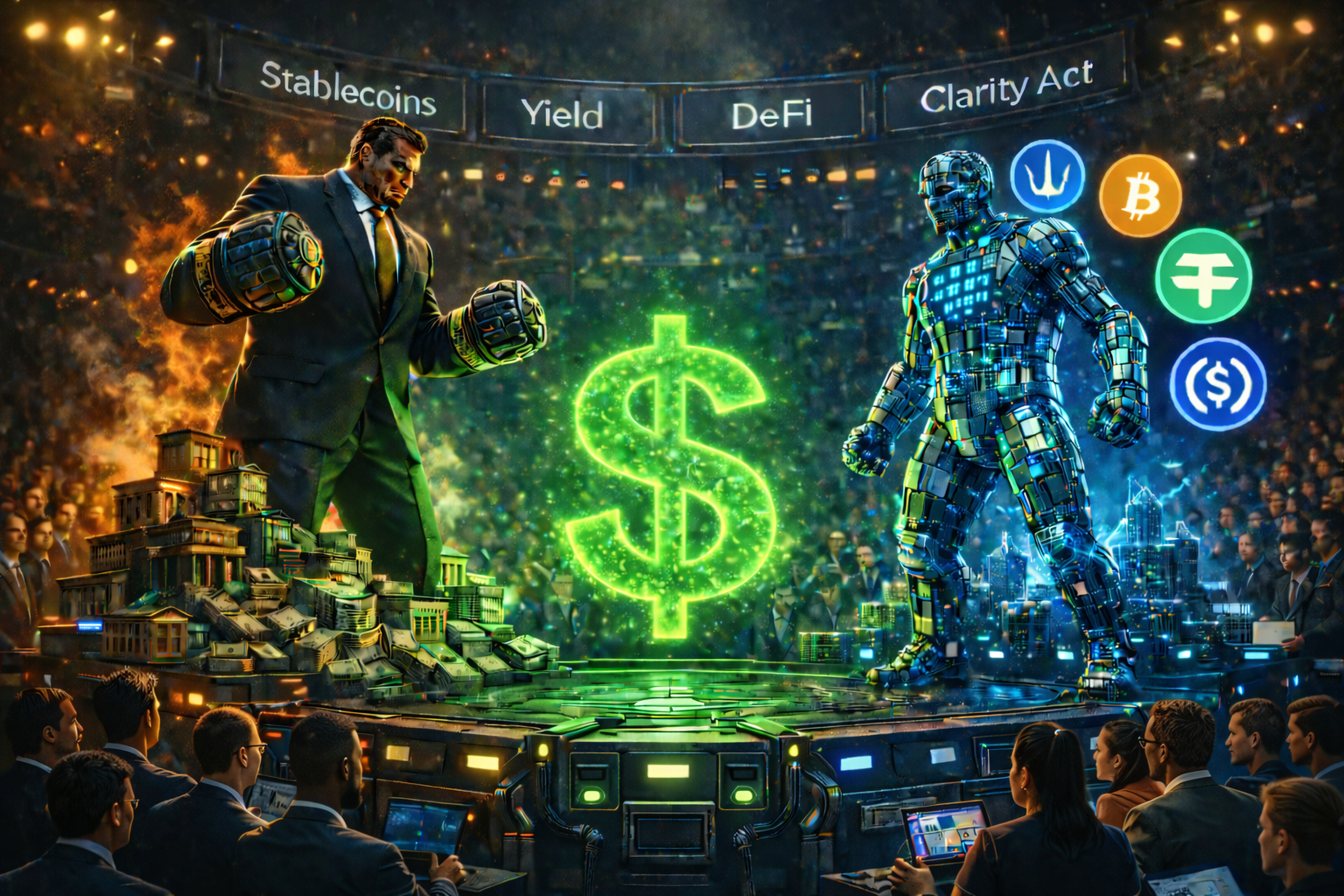
Everyone wants Clarity, right? Maybe. As noted last month, the Clarity Act is a piece of legislation that was passed by the U.S. House and is now moving through the Senate. This seminal bill will, in simplest terms, specify whether a digital asset is a commodity, and therefore regulated by the CFTC, or a security, and therefore regulated by the SEC. Clarity. Get it? Well, this is now turning into the event of the season it would seem. After Coinbase CEO Brian Armstrong famously withdrew support in January, in February it was back to the table. The main topic that needs to get resolved is stablecoin yields. Bank of America CEO Brian Moynihan went on record warning investors that up to $6 trillion could leave bank deposits and migrate into yield-bearing stablecoins if such coins are allowed to produce rewards. Banks don't want this. They want to keep your money. Conversely, a campaign called "StandWithCrypto" reported 250,000 messages sent to Congress last year, urging lawmakers to allow stablecoins to produce yield. They also added 675,000 new members and are now about 2.6M people strong5. So, then it would seem this is shaping up to be the Ali v. Frazier of crypto regulation right now. Moynihan doesn't want to lose deposits, but it's hard to ignore Armstrong when he states: "Banks earn 4.4% on reserves parked at the Fed. They pay you 0.01% on your savings account. And now they're lobbying Congress to make sure stablecoins can't offer you anything better." In the midst of this, Trump, in true Trump fashion, jumped on Truth Social and accused the banks of holding the bill "hostage." I’m not sure he’s wrong on this point.
So then, what this is really about is control… control of your money. Personally, I think this is an opportunity and exercise in free markets. If banks want your deposits, provide better returns. This is beyond any conversation of federal rates. Banks make money in lots of ways, most notably, using your money to make more money. Why couldn't they then use some of their profits to give consumers a better return? They could.
The bank side is pretty clear, so now let’s explore the world of digital assets. Users can generate yield via a centralized provider, such as Coinbase, or via Decentralized Finance, which is basically software. Let's look at the centralized version first. Coinbase, in Q3 2025 alone, generated $355 million from stablecoin yield. That's a big number, so no wonder Coinbase doesn't want to lose that. To unpack this a little bit, here's how this works for Coinbase, in its simplest form. Circle, the issuer of stablecoin USDC, pays a portion of the interest it earns on Treasury reserves directly to Coinbase, proportionate to the stablecoins held on their platform. Coinbase then passes some of that to customers as "rewards." Coinbase makes a spread. Just like banks make a spread. So, if Coinbase offers more rewards than banks and customers can get more yield, isn't that a win? Of course it is. I think, honestly, good competition is a good thing. But banks don't want to share, and hence our stalemate. That’s just part of the story though, because this is actually a fight for the existence of Decentralized Finance (“DeFi”)
DemystDeFi
So then, what in the heck is DeFi? This is a word that has been thrown around for a while but rarely unpacked… so let's unpack it. First let's look at our banks. Banks are centralized finance. They are companies that will store your money for you (and use it, by the way, in the process). They will, in turn, provide different financial instruments such as lending, borrowing, investing, etc.
DeFi allows the same things, however there is no company calling the shots, no company profiting. It is not centralized. It is a network of computers working together to provide a technology that works dispassionately to provide these products.
So, let’s do a little "DeFi 101" here, and focus on the foundation of capital markets, which is borrowing and lending. DeFi, via technologies such as Lido, Curve and Compound (just to name a few), is generally the implementation of open-source technologies that allow users to interact directly with other users for lending and borrowing. Lenders pledge their collateral (generally digital assets) and are they paid for the use of their capital. Meanwhile, borrowers use that capital and pay an interest rate. I know this makes sense so far because we all know how banks work. What is different and that needs to be stressed is that there is no company making a profit, which begs the question: "how does this system work?" This is the heart of where we are moving, so let's take a look.
In general, these technologies are ruled by Governance Tokens. Think of it as a voting right. To illustrate, let's look at Lido, one of the top DeFi technologies in the world. Lido currently has over $10B in Total Value Locked (TVL). Assets are pledged, then placed in smart contracts which control them. These smart contracts manage loan to value, capital calls, interest payments, etc. Smart contracts are just software that do certain things based on certain data. Software doesn't cheat. It doesn't bend rules. It doesn't feel pity. Or compassion. Or remorse. You have a capital call? It calls it. You cover it or it liquidates. Period. You earn a return? It gives it to you. Period.
So then, if there is no company behind DeFi, let's look behind the curtain to see how such a technology is financially incentivized to work. In this case, those that want to participate in the blockchain can set up a node which basically processes transactions on the chain. And, every time a transaction is processed there is a micro charge These micro charges are shared by the nodes and so then, all nodes in the network participate in sharing of monies earned by the protocol. What is interesting here is anyone can set up a node, jump in, and start earning.
That is just the beginning, because the real value is gleaned from control or, said differently, governance. Governance is the establishing of the rules for how the chain functions. In this the case of Lido there is a token "LDO" that gives the holder a voting right. The more LDO you own, the more voting rights you have. Simplifying this, if I hold 5% of the LDO tokens, I have 5% influence over how the chain operates. This allows me to weigh in on topics such as "how much money does the chain keep vs. how much does it distribute to node operators" and "what are the thresholds at which the chain does capital calls." The more users use a protocol and the more value locked in a protocol, the more value that protocol has. And if a protocol has value, then the ability to influence that protocol (via a governance token) has increased value as well. The laws of supply and demand keep the chains in balance. This is DeFi. It's the ultimate in democratic finance. And it's scaring the bejeezus out of banks.
No wonder the Clarity Act is currently unclear — it's at the heart of the battle for your dollar.
The Bottom Line
So, it's really this. Do we want a world of free market competition or not? From grade school on we've all learned the golden rule: "Those that have the gold make the rules." It would reason, then, that everyone wants to control as much money as possible.
From my view? The banks need to do better. They want more capital? Share more wealth. Coinbase is and DeFi is the ultimate egalitarian implementation. This is the heart of the battle for Clarity.
As investors, what does this mean? Well, Senator Bernie Moreno said on February 19 that the Senate Banking Committee is meeting almost daily to fast-track the bill, and that passage by April is realistic. Passage of Clarity would be, in my opinion, very bullish. But if the war for your money drags on and passage is delayed to 2027 or later, this will likely cause our rambling bear to ramble on. What are the odds? Polymarket has passage in 2026 at 70%. Given that, I suppose, the odds are ever in our favor….
The Bear Necessities
Yeah, we're in a bear. But it may not be as unbearable as the past ones have been. While Bitcoin is down 23% YTD11, we have to look at the fact that according to a BofA study cited by Pantera Capital, over 67% of institutional managers still have zero (0, zilch, zip) exposure to this asset class. We have so little adoption that we don't even have a floor. Now let’s add to that another data point from Goldman Sachs, which is that 71% of institutional asset managers plan on increasing crypto exposure in 2026 Clarity passing will help. But our macro numbers are also moving in the right direction as we have the ISM above 50 in both January and February. From my seat, impending demand + data builds the case for a green year.
401OK!
For years, the Department of Labor (DOL) was basically standing at the door of your 401(k) with a clipboard saying "not so fast." Their 2022 guidance told plan fiduciaries to exercise "extreme care" before adding crypto to retirement plans (And, by the way, you might expect an investigation if you do). Unsurprisingly, most plan administrators said "no thanks" and moved on, leaving $10 trillion in retirement assets sitting on the sidelines.
Well, not anymore. On May 28, 2025, Secretary of Labor Lori Chavez-DeRemer pulled the plug15, saying: "The Biden administration's DOL made a choice to put their thumb on the scale. We're rolling back this overreach and making it clear that investment decisions should be made by fiduciaries, not DC bureaucrats." Just like that, the "extreme care" language was gone.
Now, and this matters for the fiduciaries reading this, this change does not mean the DOL is endorsing crypto in your retirement account. It does however signal that they have returned to a neutral stance. Meanwhile, the safe harbor rule that would give plan administrators genuine legal cover is still being finalized, currently sitting with the Office of Management and Budget. In fact, I bring this up now, even though this happened 8 months ago, because, On January 13, 2026, the DOL submitted proposed rules to the White House Office of Management and Budget. OMB typically has 90 days to review, meaning the proposed rules could be released for public comment as early as April 2026. We’re talking big money moving here, and that big money is one more factor that will become a part of our demand wave. I’ve said it before and I’ll say it again. I think it’s going to be Tsunami sized, so grab your swim trunks and get ready now.
BlockchAIn
Meanwhile, let's deviate from our market focus to look at what is truly important — how these technologies are preparing to change the world. Specifically, let's look at the world where it's damn near impossible to tell the difference between AI-generated content and real content. Just a couple of years ago, a finance worker at global engineering firm Arup was spoofed into wiring $25 million to fraudsters. How? The victim attended a video conference call featuring AI-generated deepfakes of the company's CFO and other senior executives. Every person on the call was fake. Every. Person. It was an entirely deepfaked Zoom call.
That. Is. Scary, and AI has significantly advanced since 2024. So, what's our answer? Know. Your. Content. To that end, the C2PA (Coalition for Content Provenance and Authenticity) is building a cryptographic "nutrition label" for all digital content. This is a statement of provenance that is baked in at the moment of creation, and allows us to confirm what content is real and what is not. Members include Adobe, Microsoft, Google, OpenAI, Meta, BBC, AP, Sony, Amazon and Canva. This means that creators of content are now stamping their output with cryptographic proof of authenticity, which includes blockchain timestamping for the part that matters most: a permanent, tamper-proof public record that no single company controls that guarantees that the media you are interacting with is, indeed authentic.
And it's happening now. Google Pixel 10, as of September last year, signs every photo by default. And the Content Authenticity Initiative has over 5,000 members including Nikon, Leica, Canon, AP, BBC, Reuters and others, all committed to promoting the standard. This is the start we need, and I expect it will grow. The point is this: we can't outrun AI fakes by trying to detect them after the fact. The only sustainable solution is to cryptographically prove what's real at the moment of creation. That's where blockchain's immutability becomes critical, not as a detection tool, but as the permanent, tamper-proof authenticity record. Now, this won’t resolve your 10:00 PM doomscrolling habit but, in the very near future, you'll be able to tell if what you are looking at is, in fact, authentic. And that's a good thing.
In Closing
I’ll keep this brief. we need Clarity. And it seems the boss fight is underway, with big banks battling blossoming blockchain to see who will win. I do think at the end of the day it will be consumers, as free market economies tend to prevail. But until then we'll keep bearing the brunt and hibernating, waiting for spring when we can all head to the beach and ride the impending demand tsunami. Honestly y'all, I really don't think it's too far away.
That’s all for now! Until next time be well, stay safe, and I’ll keep Decrypting Crypto for you!